
Home / Route tax
The small print on the route card: Tax free, DDP, IOSS
You choose a route before you declare. Its labels decide how tax is collected, not what your goods are worth. Read them before you fill in the amount.
Reading a route card, start to finish
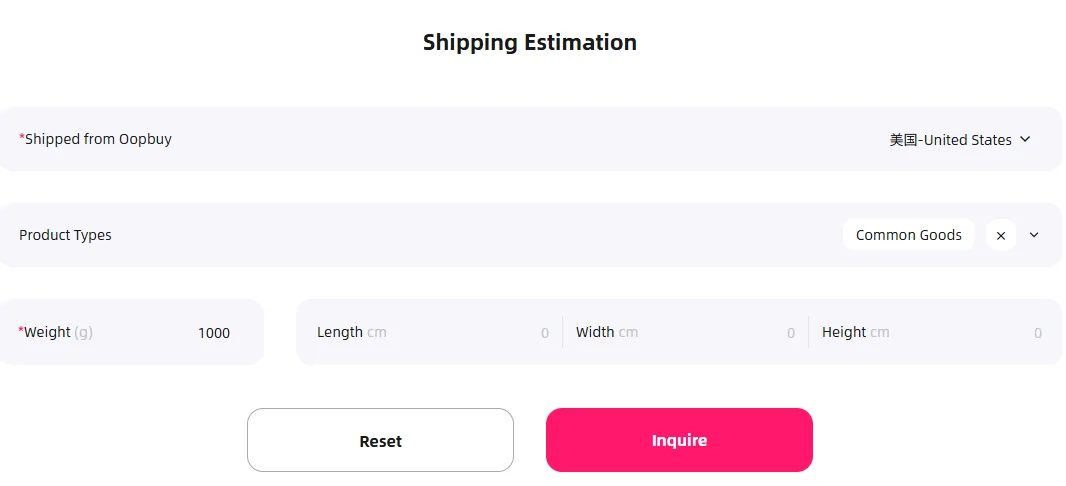
Oopbuy's public estimator lists routes for a destination, weight and product type. On 10 October 2026 we asked for 1,000 g of common goods to the United States and got 23 routes back. Each card shows a cost, a time range, a delivery success rate, small green labels and a block of route notes.
The labels that matter for declarations are the tax ones. Two kinds appear on US routes: Tax free and DDP.
Tax free: what the route notes say
Most of the cheap US lines carry a Tax free label. Their notes read “tax inclusive channel, commercial customs clearance” and call the line a tax-packed parcel line. In other words the route operator clears the goods and the tax is built into the route price.
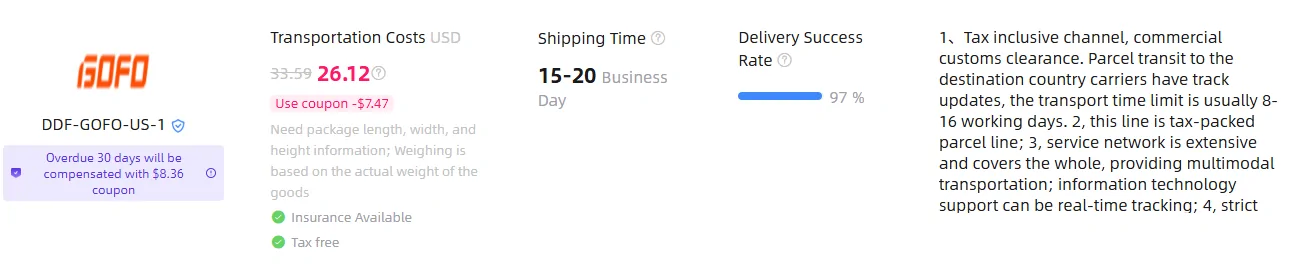
A Tax free label does not make the declaration optional or the amount irrelevant. The route still carries your declaration, and the route notes list items it will not carry, such as liquids, powders and pastes.
DDP and routes where you help with clearance
HF-EUB-US-1 shows a DDP label and a note that if there are customs-related issues, the recipient will be required to assist with clearance; its weight limit is 5 kg. The estimator summary for that day lists DDP lines with a 50 CNY clearance fee. Another line, ZF-UNI-US-1, calls itself a duty-free channel that can carry shoes and clothes but not liquids, creams or power banks.
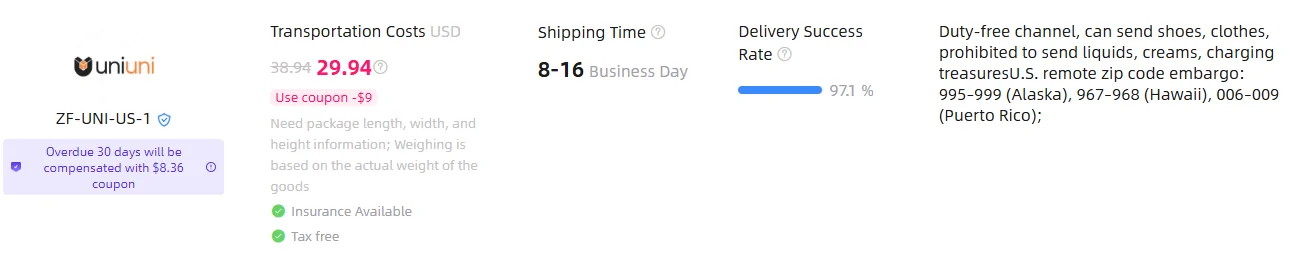
Read the notes, not just the label. The same word can sit next to different clearance arrangements.
Recipient tax: when the bill comes to you
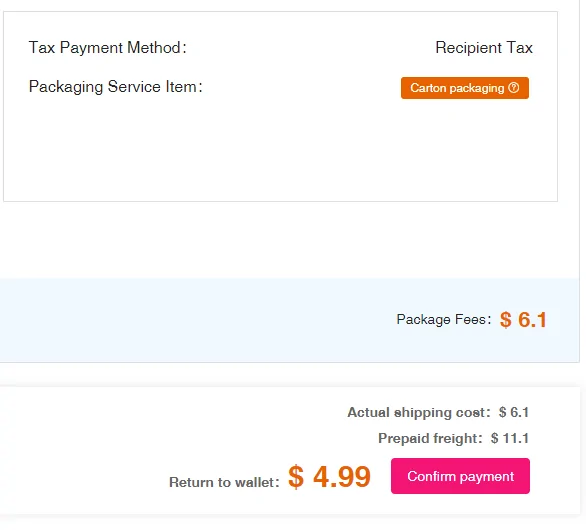
Oopbuy's 2024 tutorial shows a checkout panel with Tax Payment Method: Recipient Tax. On such a route, duties and VAT assessed at the destination are collected from you at delivery, by the carrier or customs.
That is where the declared value has a direct effect, because it is the starting point for the assessment.
The assessment and collection sequence depends on the destination and service. A carrier may request records or payment before release or delivery. Customs can examine the invoice, conversion and additional valuation elements even when the entered goods price matches your receipt. Keep the invoice accessible, check the request through the carrier’s official tracking or support channel and respond within its stated deadline.
IOSS on EU routes
IOSS is an EU import-VAT collection scheme for eligible distance sales in consignments not exceeding 150 EUR, with exclusions. It is not a customs-duty exemption or a permission to reduce the value. Confirm the selected route, transaction and destination eligibility.
The operator note read 10 October 2026 describes an input floor and an edit lock. Those are claims about its form, not the legal valuation rules. Check the current account controls before submission and ask about the correction process if an error is found.
The same dated note describes asking for a prepaid-tax refund with receipts if tax is collected again. Confirm the current process and retain both payment records; a refund is not automatic.
Destination tax bases can include more than the item price. See the European Commission’s import-VAT explanation. Reviewed 19 October 2026.
The operator's threshold table, and why we do not reprint it
The operator’s old threshold table is a dated reference, not current country guidance. Its 800 USD US row should not be used as a present duty-free promise. CBP’s 8 October 2026 rulemaking background describes the de minimis suspension and the June 2026 interim rules; the new filing proposals in that document are separately identified as proposals. CBP background and proposal.
For the UK, Great Britain and Northern Ireland have different coverage and duty conditions. Imported purchases, qualifying gifts and excise goods also differ. Consult GOV.UK tax and duty guidance for the actual destination. Reviewed 19 October 2026.
A route label cannot replace these rules, and this site does not calculate a destination tax assessment.
Customs detention insurance and its exclusion
The 2024 tutorial illustrates delay, loss/damage and customs-detention options during a limited-time offer. That picture does not establish present coverage. Read the protection purchased for your actual parcel, its insured limit, evidence requirements, time limits and exclusions.
The dated operator wording excludes some failures to cooperate with clearance or tax payment. A claim is subject to the applicable service terms; a declaration worksheet result cannot establish eligibility.