
Home / Unreasonable declarations
Shoes at a dollar, a ten-kilo ring, a thousand-dollar guess
Oopbuy's declaration FAQ ends with three short scenarios. They are presented as reference only, but they are the clearest statement the operator makes about what a declaration must not look like.
The three scenarios in Oopbuy's words
“Scenario 1: Assuming you declare 3 pairs of shoes with a declared amount of $1, the item clearly does not match the amount. Scenario 2: Assuming you have a 10KG item, the declared item is a ring, and the item does not match the weight significantly. Scenario 3: Assuming that your current package has a total value of approximately $200, and you declare a total value of $1000 for the goods, there is no need for the declared value to exceed the actual value.”
From the official help page “How to choose the declaration method”, read on 10 October 2026.
Each scenario compares the declaration with something customs can check without trusting you: the items it can see, the weight on the scale, and the value of the goods. When the paper and the parcel disagree, the parcel wins.
Scenario 1: an amount that does not match the items
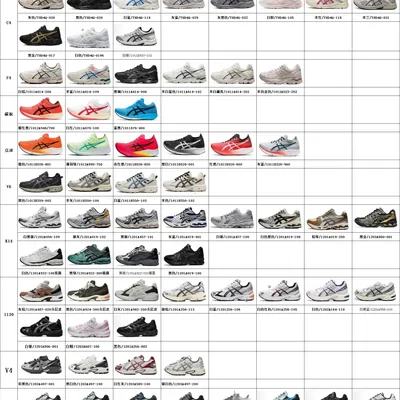
Three pairs of shoes declared at one dollar. Nobody believes that, and nobody has to: an X-ray or a glance inside the box shows three pairs of shoes. The declaration then does the opposite of its job. Instead of letting the parcel pass quietly, it marks it as worth a closer look.
This is the low-declaration case, and it is the one people are most tempted by. Oopbuy's tariff FAQ notes that parcels under a country's threshold are normally not taxed, then adds in brackets that fraud declaration is another matter.
What a low declaration can cost
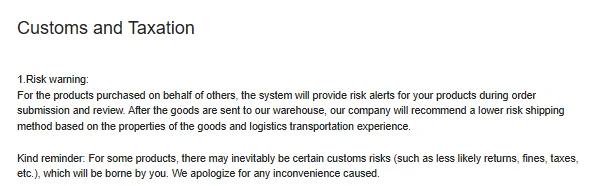
Oopbuy's Customs and Taxation page lists the risks that land on you: returned packages, fines and tax payments. Its customs inspection note adds that when customs considers a parcel special, it will usually contact the recipient for an invoice or clearance documents, and that if the recipient cannot be reached or does not cooperate, the cost of returning or destroying the parcel is borne by the recipient.
Put those together and a one-dollar declaration has three likely outcomes: it passes, it is reassessed at the real value with tax due, or it is held while you produce an invoice that contradicts your own declaration. None of these scenarios makes an inaccurate declaration acceptable; use the correct information and retain supporting records.
Scenario 2: an item that does not match the weight
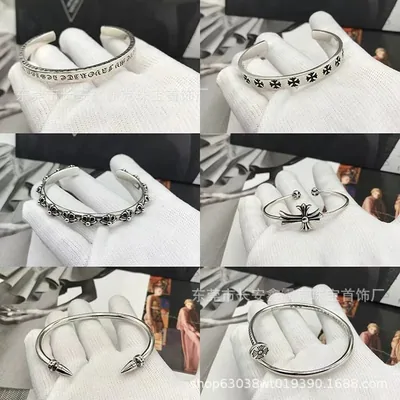
A 10 kg parcel declared as a ring. The amount might even be reasonable for a ring. The problem is the description: rings do not weigh ten kilograms, and every parcel is weighed many times between Xiamen and your door.
This is the mis-described case. It often comes from accepting a vague pre-filled type, or from writing the most valuable item in the box as if it were the only one.
Description and weight are checked against each other
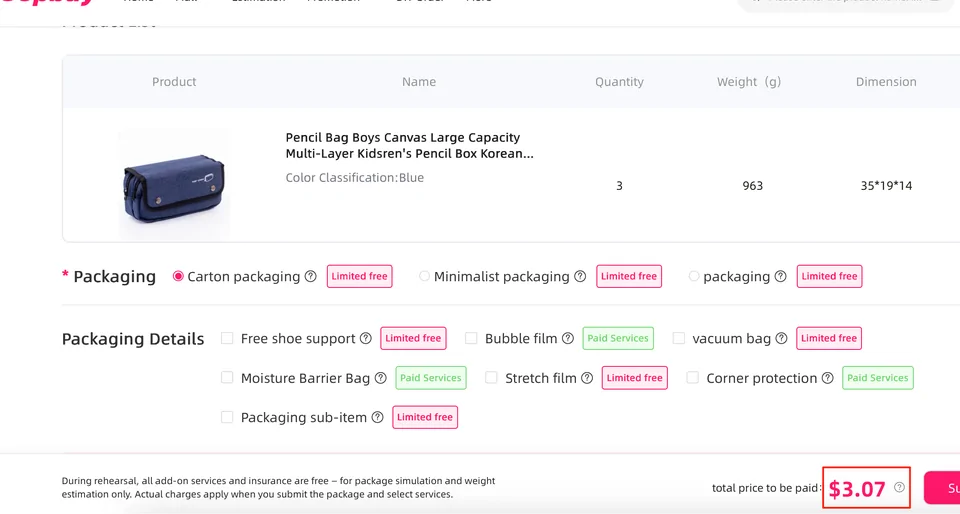
Oopbuy weighs every package on arrival at the warehouse, and the parcel is weighed again for billing on the route you pick. Carriers and customs work with that weight. Your declared item types are the story; the weight is the evidence. The fix for scenario 2 is to make sure each line names what is really in the box, in roughly the right proportion.
In self declaration that means editing the pre-filled types. In fuzzy declaration you cannot edit them, so check the generated summary if the form shows it, and pick self declaration when the box is mixed.
Scenario 3: a value higher than the parcel is worth
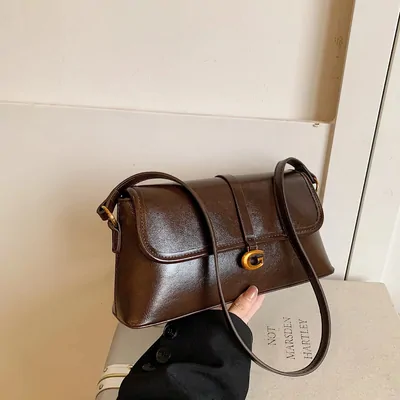
A parcel worth about $200 declared at $1,000. People do this for two reasons: to make an insurance claim look bigger, or because they read that a higher value is somehow safer. Oopbuy answers both with one sentence: there is no need for the declared value to exceed the actual value.
Over-declaring raises the tax base in countries where tax is charged on value, and the insurance text pays on the actual value of the goods up to the insured amount, not on the declared figure.
The edges of a reasonable declaration
| Scenario | Direction | What customs can compare it with | Fix |
|---|---|---|---|
| Shoes at $1 | Value too low | Visible items | Declare what you paid |
| 10 kg ring | Wrong description | Weight | Name every item type |
| $200 at $1,000 | Value too high | Receipts, invoice | Declare what you paid |
Read the table across and the rule appears: a reasonable declaration is one that survives comparison with the parcel itself. Oopbuy says it in eleven words, and this whole site is a long version of them.
Questions people ask about the three cases
Is it illegal to under-declare?
Customs rules belong to your country, and this site does not give legal advice. What Oopbuy states is that unreasonable declarations may affect clearance and that the risks are yours. Declaring the actual value removes the question.
What if the seller's receipt shows a discount?
Then keep the discounted purchase record and check how the destination valuation rules treat the discount and any additional costs.
Will Oopbuy change my declaration?
The pages we read do not say Oopbuy edits declarations. They describe risk alerts at order submission and review, and a suggested lower-risk route once goods arrive.
Is a gift declared differently?
Oopbuy's pages do not cover gift declarations. Goods you bought are goods you bought.
Next: why weight and identical items matter.
Commercial parcel signals